On X and Twitter, revenue screenshots have evolved into a strange kind of social currency, where a neatly cropped Stripe graph can apparently substitute for years of execution, customer support, churn battles, and the deeply unglamorous reality of building an actual business. Scroll long enough and you will inevitably encounter founders announcing five-figure MRR achieved in record time, usually accompanied by a triumphant caption, a fire emoji, and a promise that all will be revealed if you simply reply “GAMEPLAN.”
Seasoned builders, unsurprisingly, tend to react less with awe and more with a raised eyebrow.
The issue has never really been that people succeed quickly. It is that there has been no reliable way to tell the difference between genuine momentum and a carefully cropped dashboard that conveniently excludes refunds, churn, or the small detail of the timeline.
That gap is exactly what indie hacker and YouTuber Marc Lou decided to address with TrustMRR, a product whose core value proposition can be summarised as: “show the numbers, or stop pretending.”
The Fake Screenshot Economy
In the indie and bootstrap ecosystem, screenshots are persuasive largely because they feel concrete, even though anyone with basic design skills, or frankly just a browser and a bit of confidence, can fabricate something that looks convincing enough for social media consumption.

A graph implies objectivity, despite the fact that date ranges can be selected, months can be omitted, and numbers can be framed in just the right way to imply unstoppable growth rather than “one good month followed by silence.”
Well-known builders such as Pieter Levels have repeatedly pointed out that the economics of real businesses are rarely so cinematic. Sustainable recurring revenue usually takes years of experimentation, distribution work, failed ideas, rewrites, rewrites of rewrites, and long stretches where nothing seems to work particularly well.

The screenshot economy, however, rewards spectacle over durability, which is excellent for engagement metrics and significantly less helpful for anyone trying to learn how businesses actually get built.
Without verification, newcomers are left guessing which success stories are instructive and which are closer to performance art.

TrustMRR: Verification
TrustMRR approaches the problem with a refreshingly boring solution, which is often a strong signal that it might actually work.
There are no uploads, no screenshots, and no opportunities for “creative interpretation.” Instead, founders connect their Stripe account using a read-only API key, a detail that immediately filters out anyone who prefers aesthetics over accuracy.
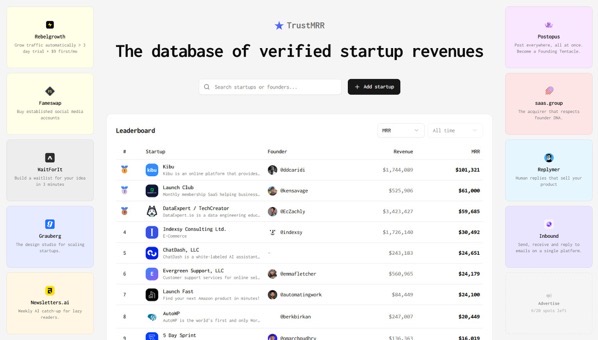
Once connected, TrustMRR generates a public page displaying verified revenue metrics such as current MRR and recent revenue history, all pulled directly from Stripe and rendered on Marc’s servers, which means the numbers cannot be edited, cropped, enhanced, or gently massaged to look more impressive than reality allows.

That design choice is doing a lot of quiet heavy lifting. Read-only access ensures no money can be touched, while also making it impossible to fabricate results. Either the revenue exists, or it does not, and no amount of motivational tweeting can change that.
To make participation attractive rather than purely virtuous, verified founders receive a public profile, a dofollow backlink, and inclusion on a revenue-ranked leaderboard, which turns transparency into something that is not only ethical, but socially and commercially useful.
A Public Leaderboard That Changes Incentives
The TrustMRR leaderboard is where the product really starts to influence behaviour.
Instead of vague claims and selectively framed milestones, founders are compared on the same metrics over the same time windows, which has the subtle but important effect of removing storytelling gymnastics from the equation.
Posting inflated numbers now carries reputational risk, because verification is available and conspicuously absent when someone declines to use it. Posting verified numbers, even when they are modest, signals confidence and credibility in a way that screenshots never quite manage.
Smaller founders benefit by being taken seriously earlier, while larger businesses can demonstrate scale without asking anyone to simply “trust the process.”
In practice, TrustMRR is less about bragging rights and more about filtering noise, giving investors, journalists, and other founders a quick way to sanity-check claims without needing a detective’s mindset.
TrustMRR in Context: Marc Lou’s Builder Pattern
TrustMRR makes much more sense when viewed as part of Marc Lou’s broader body of work rather than a one-off reaction to Twitter nonsense.
He is best known for ShipFast, a SaaS boilerplate designed to help founders launch paid products quickly, complete with authentication, billing, and marketing pages, so they can spend less time wiring infrastructure and more time discovering whether anyone actually wants what they are building.
ShipFast itself became a case study in the kind of growth Marc tends to advocate: sell early, stay transparent, iterate in public, and resist the temptation to inflate numbers for attention.
Alongside his products, Marc runs a YouTube channel where he documents builds, failures, revenue figures, and uncomfortable truths in a level of detail that makes fake screenshots look particularly lazy by comparison. TrustMRR feels credible largely because it reflects how he already operates, rather than asking others to adopt standards he avoids himself.
How TrustMRR Was Built and Monetised
Technically, TrustMRR is not complex, which is precisely the point.
It relies on Stripe’s existing trust and API infrastructure, server-side rendering to prevent tampering, and public pages that double as social proof and organic distribution. There are no unnecessary features, no “AI-powered insights,” and no attempt to turn verification into a lifestyle brand.
From a business perspective, it follows a familiar Marc Lou pattern: identify a real irritation, build a narrow tool that solves it cleanly, ship fast, and let the audience do most of the distribution.
TrustMRR is monetised through paid verification tiers and premium exposure rather than ads, enterprise contracts, or vague promises of future scale. The margins are high, the scope is deliberately constrained, and the product compounds socially as more credible founders opt in.
Why TrustMRR Actually Works
TrustMRR works because it does not try to lecture anyone or enforce behaviour. It simply changes the incentives.
Founders who value credibility opt in, because the upside is obvious. Founders who rely on exaggeration quietly opt out, which is also informative in its own way.
Over time, that separation creates a cleaner signal for anyone paying attention.
In an ecosystem increasingly shaped by algorithms, engagement hacks, and performative success, TrustMRR offers something deeply unfashionable but increasingly valuable: evidence.
It will not eliminate fake claims entirely, but it raises the bar just enough to make dishonesty less convenient. And in a space where trust has been steadily eroded by cropped screenshots and improbable timelines, that alone makes TrustMRR one of the more quietly important indie products to emerge in recent years.