Julian Gargicevich was not actively looking to start a fitness company, he was just lifting weights, following an app that promised smart workouts, and slowly realising that while the interface was beautiful, the workouts themselves were strange at best and borderline dangerous at worst.
Instead of doing what most people would do, which is uninstall the app and complain to a friend who does not care, Julian did the much more developer-specific thing of thinking, “What if I rebuilt this properly,” and then actually following through with it.
Two years later, that decision turned into Gravl, an AI-powered fitness app with more than 70,000 paying subscribers, generating over $440,000 in monthly revenue and, as we have seen several times at The Startup Series, once again proving that cloning something popular and fixing the parts everyone tolerates but secretly hates can be an extremely profitable business model.

Growing up in a gym, accidentally training for a startup
Julian grew up in Argentina in a household where fitness was not a hobby but part of daily life, mostly because his dad owned a gym, which meant his after-school hours were spent lifting weights, playing sports, and absorbing an understanding of training that most software engineers only discover after their third knee injury.
Software engineering came later, followed by a move to Australia, where Julian worked across small startups and much larger companies like Atlassian, along with stints in media and even an investment fund, slowly building technical depth while quietly learning how products scale and how businesses actually make money when they are not pretending to be disruptive on Twitter (I refuse to call it X).
Like many technically capable founders, Julian and his partners eventually decided they should start something of their own, which initially took the form of an influencer marketing platform for mobile games, before drifting into something far less glamorous and far more common, a marketing agency.
Nobody particularly enjoyed that phase, but it came with one very useful side effect, which was a deep, practical education in user acquisition, ad economics, and the uncomfortable realisation that consumer apps, especially fitness apps, print money when they work.
The MVP that worked but did not matter
Gravl did not start as the app that exists today, and this is the part that makes founders uncomfortable, because the first version was fine, functional, and completely unremarkable.
Julian initially built a workout tracking app in the same category as Hevy or Strong, which technically worked and solved a problem but added very little new value, and as he built it, he could feel that uncomfortable sense of familiarity that comes from recreating something that already exists without meaningfully improving it.
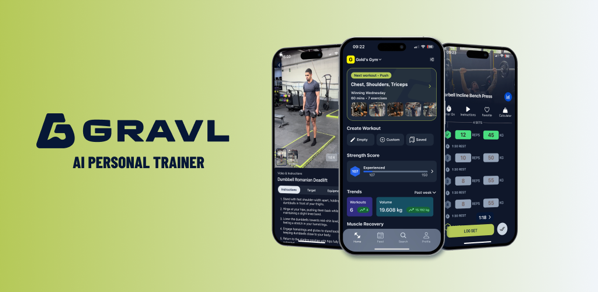
The turning point came when a friend showed him Fitbod, an app that had nailed the user experience so well that it felt almost magical, generating workouts automatically and removing the cognitive load of planning gym sessions, which Julian loved right up until he started following the workouts and realised that the logic underneath the polish was, to put it politely, not great.
Exercises were oddly programmed, progressions felt unsafe, and the more he used it, the more obvious it became that the algorithm had been optimised for engagement rather than actual training quality, which is a risky trade-off when barbells are involved.
That was the moment Gravl stopped being a tracker and became a proper product, because the goal was suddenly clear: keep the UI and UX people loved, but rebuild the workout engine from scratch so that it behaved like it had been designed by someone who had actually trained before.
Two months, one clone, and a lot of painful logic
The real MVP took around two to three months, depending on how generously you count the earlier tracker phase, and most of that time was spent not on flashy features but on the deeply unsexy problem of business logic.
Generating sensible workouts is deceptively complex, because you are not just picking exercises but balancing equipment availability, training frequency, experience level, goals, recovery, gender, age, previous performance, and the uncomfortable truth that people lie about how often they go to the gym.
Each variable multiplies the number of possible outcomes, and every edge case creates another way to annoy or injure a user, which meant a lot of iteration, testing, and refinement before the workouts felt consistently human rather than algorithmic.
This was also the part that made the app defensible, because while the UI could be copied in a weekend, the underlying logic took months of iteration and domain knowledge that is hard to fake.
Reddit, developers, and the first real signal
Julian has strong opinions about distribution, and one of them is that Reddit is still criminally underused by builders who are willing to be transparent rather than promotional.
He posted a detailed thread explaining how he built Gravl, which at the time was called Games AI, focusing on the technical side rather than the business pitch, and within hours it was pulling in hundreds of likes, hundreds of thousands of impressions, and a flood of users who were developers, gym-goers, or both, and who felt comfortable testing an unfinished product.
The app was free at that point, which lowered friction, but the important signal was not downloads, it was usage, feedback, and the steady stream of bug reports and feature requests that only arrive when people actually care.
That feedback loop was the final push, because it confirmed that this was not just an interesting project but something people wanted badly enough to complain about.
The first subscription and the moment everything changed
When subscriptions were added and ads were turned on, Julian experienced a moment that every founder remembers with uncomfortable clarity, which is watching the first payment come through and realising that a stranger has just given you money for something you made.
It happened within ten minutes.
That small, irrational high became the foundation for a much more disciplined growth strategy, starting with tiny ad budgets, often under $50 a day, and a deliberate focus on Spanish-speaking markets in South America, where Julian and his co-founders had a cultural and linguistic advantage and where competition was significantly less aggressive than in the US.
The result was a slow, repeatable scaling process that prioritised sustainability over vanity metrics, and it worked well enough that paid ads eventually became the main growth engine without ever feeling like a gamble.
How Gravl quietly crossed $4M a year
There was no single trick, no secret channel, and no sudden viral explosion, just a lot of testing, iteration, and a willingness to copy what already worked rather than chasing originality for its own sake.
User-generated content consistently outperformed polished creatives, cheap influencer deals beat expensive productions, and copy mattered far more than tools, especially when paired with the Meta Ads Library, which openly shows you what your competitors are spending money on if you bother to look.
Julian is refreshingly honest about this part, because his advice is essentially to stop trying to be clever and start by copying what already converts, then iterating from there until you understand why it works.
What the product actually feels like
Gravel is built around a single core flow, which is the active workout, and almost everything else exists to support that moment.
Onboarding asks a long list of questions, not because it looks impressive, but because generating good workouts requires context, including experience level, goals, equipment, training split, recovery, and even external activity pulled in from Apple Health or Strava.
Before users see their full plan, they hit a hard paywall, which scares many founders but turns out to convert extremely well when the value proposition is clear and the promise feels specific.
Inside the app, workouts adapt dynamically, weights adjust based on fatigue and exercise order, recovery scores influence future sessions, and support is handled by real humans, 24/7, which users value far more than another AI badge on the homepage.
The numbers nobody likes to talk about
Roughly a third of revenue goes to ads, salaries are the second largest cost, and the team has grown from three founders to around 13 or 14 people including contractors, with Apple taking its usual cut and infrastructure costs remaining relatively modest by comparison.
It is not cheap to run, but it scales cleanly, which is the kind of boring sentence investors love and founders learn to appreciate.
Advice to founders
Julian’s biggest lesson is to validate willingness to pay before pouring money into ads, to look beyond the US for early traction, to start smaller than feels comfortable, and to accept that volume and iteration beat perfection every time.
He is also clear about something founders avoid saying out loud, which is that knowing when to quit is just as important as knowing when to push, and that Gravl only exists because a previous startup was allowed to die instead of being dragged along out of stubbornness.
What makes this story work is not just the revenue number, impressive as it is, but the alignment between the founder and the product, because building something you actually care about makes it much easier to keep going when the numbers are small, the ads fail, and nobody is watching.
Sometimes the most profitable ideas are not the most original ones, but the ones where someone finally fixes the thing everyone else has learned to tolerate, and does it well enough that people are happy to pay for it every single month.
Is improving on existing, profitable apps the simplest way to make money online? Other founders like Pavlo at Calday suggest it might be.