Many people spend a long time thinking about when the right moment might be to build a SaaS, whether that is after learning to code properly, finding the right idea, or just feeling a bit more confident, while Sam, a university student with no coding background, built his first SaaS in six or seven months, shipped something that only partially worked, validated it by quietly screen-sharing in Discord voice chats, and ended up doing over $40,000 in monthly revenue without ever relying on spammy promotion.
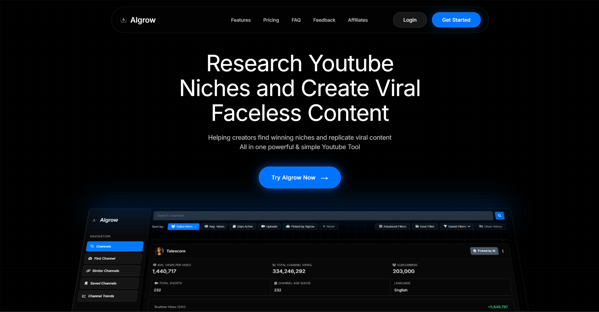
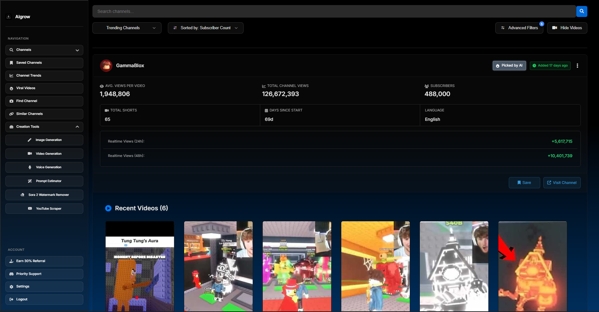
Sam’s product is called Algrow, and if you strip it back to its core, it does two things very well for creators who care about growth rather than vibes: it helps them research what formats are actually working on platforms like YouTube and Shorts, and it helps them replicate those formats quickly without guessing. The tool analyses subscriber counts, average views per video, and real-time trends, then lets users save channels, generate videos, optimise them for different platforms, and publish without spending weeks reverse-engineering why one faceless channel is suddenly exploding while another quietly dies.
There are three pricing tiers, starting at around $25 a month and topping out near $80, and as of the last 30 days Sam shared publicly, Algrow was pulling in roughly $14,000 a month with just under 500 new paying customers, which is not bad for something that started life in Notepad and once greeted its first user with a friendly Heroku application error.
A SaaS founder who didn’t know what VS Code was
What makes Sam’s story interesting is not that he “used AI to code”, because at this point that is barely news, but that he genuinely had no technical background and no grand plan to become a founder. He had spent a few years online experimenting with ways to make money, starting with affiliate marketing and faceless social content, even pulling in over $10,000 promoting an app through short-form stories, before realising that most of these models were fragile, platform-dependent, and not something you want to build a long-term business on.
The idea for Algrow came from YouTube automation and shorts channels, where the real bottleneck was not editing or posting, but simply finding formats that already worked and could be replicated at scale. Sam did what many people do at this point, which is open a blank file, talk to an AI in voice mode, copy chunks of code into Notepad, and hope the universe does not notice what is happening.
Eventually someone told him to download Visual Studio Code, which he did without really understanding why, and then a friend pointed out that “raw dogging VS Code” was unnecessary when tools like Cursor exist, at which point Sam assumed they were talking about a mouse pointer. They were not.
Within about a week he had an MVP, hosted it on Heroku, and shipped it, bugs and all, because the core idea worked well enough that users could still get value even when parts of the app were falling over. That detail matters, because too many founders wait for “working perfectly” when “working just enough” would have been fine.
Validating demand without asking anyone’s permission
Where this story really gets interesting is how Sam validated the idea and found his first users, because it did not involve Product Hunt, cold emails, LinkedIn posts, or pretending to enjoy Twitter discourse.
Instead, he went to disboard, typed in keywords related to niches and monetisation, and started joining small Discord servers where people were already asking the same questions over and over again, usually variations of “how do I find a niche” or “how do I replicate this channel”.
Rather than posting links or pitching anything, Sam joined voice chats, shared his screen, muted his mic, and simply used his own tool in front of people. Predictably, someone would ask what he was using, he would reply that it was something he built, and the conversation would go from there.
He did this repeatedly for about a week, long enough that the server owner noticed, liked what he saw, and made a long-form YouTube video about Algrow without being asked or paid. At that point, Sam had proof of demand, proof that people would talk about the product organically, and a clear signal that this was worth pushing further.
When it came time to convert interest into users, he did not reinvent the wheel. He created a simple waitlist, shared it in the same communities where he had already built rapport, and invited people to sign up if they wanted early access. That was the real beginning of Algrow as a business rather than a side experiment.
Why Discord worked when everything else would have failed
Discord has a reputation problem, mostly because it is full of people who ignore server rules, drop links, get banned, and then complain that “Discord doesn’t work for marketing”. Sam’s experience was the opposite precisely because he did not market at all in the traditional sense.
He spent time helping people using his own tool, answered questions, and solved real problems in public before ever asking for anything in return. When users started paying, a large chunk of them came via word of mouth, with people telling their friends because the product solved a specific, painful problem they already cared about.
The advice Sam gives now is refreshingly practical. Find where your ideal customer actually spends time, join those communities quietly, read chat history to understand recurring pain points, validate ideas through real conversations and quick demos, and then build with your users rather than shouting at them from outside the room.
One particularly smart move was creating a private Discord server for Algrow itself, which meant he could build a community without risking bans in larger servers, and turn early users into advocates by giving them free access so they could show the product to friends who were still on the fence. Emails still mattered, but for his younger audience, Discord was simply where relationships formed faster.
The stack, the costs, and the unglamorous reality
Algrow today runs on a fairly typical modern stack for an AI-heavy SaaS, with Cursor at the centre of development, paid AI image and video generation models, hosting on Heroku, email marketing via tools like MailerLite, and monthly infrastructure and compute costs that now sit in the low thousands once everything is added up.
The important part is not the exact tools, but that Sam built with scale in mind early on, even if he did not fully understand what that meant at the time. His advice to his younger self is simple but surprisingly rare: assume success, design for it, and prompt your tools as if you expect tens of thousands of users, because it is far cheaper to think that way from day one than to retrofit everything later when you are already busy.
The boring lesson most people will ignore
If there is a takeaway here, it is not “use Discord” or “vibe code with AI”, but that distribution comes from understanding where real conversations already happen and showing up as a useful human rather than a walking call to action.
Sam did not get lucky. He paid attention, shipped early, tolerated embarrassment, and spent time in places most founders ignore because they do not look scalable or impressive on a pitch deck. Six months later, those unglamorous decisions are the reason he has 10,000 users, five-figure monthly revenue, and a SaaS business that started life with a broken MVP and a muted microphone.